Chew, React, Repeat: How Thai Candy Became the Ultimate Mukbang Star

Photo: U.S. Army 126PAOC by Capt. Jessica Jackson, Public domain, via Wikimedia Commons
Somewhere between a Bangkok night market stall and a ring-light-lit bedroom in Ohio, something unexpected clicked. A creator unwrapped a small packet of tamarind candy, popped it in their mouth, and let the camera catch every single second of what happened next — the wince, the slow nod, the "okay, actually, that's amazing" eyes. The video hit a million views before the week was out.
That moment, repeated in thousands of variations across TikTok, YouTube, and Instagram Reels, pretty much sums up why Thai candy and mukbang culture were always destined to collide.
What Even Is a Mukbang, and Why Does It Work So Well?
For the uninitiated: mukbang (a mashup of Korean words for "eating" and "broadcast") started in South Korea around 2010 as a way for people to feel less alone at mealtimes. Creators would sit in front of a camera and eat — sometimes a lot — while chatting with their audience. Simple concept. Wildly effective.
The format migrated to Western platforms and evolved into something a little more chaotic and a lot more snack-focused. Reaction videos, taste tests, and blind challenges became their own lane within the broader mukbang world. And that's exactly where Thai candy found its opening.
"Thai candy is basically made for the camera," says Destiny Calloway, a Dallas-based food creator with nearly 400,000 followers across her platforms. "The colors are insane, the textures are unexpected, and the flavor combinations genuinely surprise you — even if you've been doing this for years. You can't fake that reaction."
She's right. Authenticity is the engine of mukbang content, and Thai candy delivers it on a silver platter.
The Camera Loves These Flavors
Not every snack translates to great video. A plain cracker? Boring. A chip that tastes exactly like you expected? Fine, but forgettable. Thai candy, on the other hand, is practically engineered to produce a moment.
Take the classics: tamarind-chili candies that hit sweet, then sour, then spicy in a rolling wave that plays out visibly on a creator's face. Coconut-milk jellies with a texture so unique that first-timers inevitably pause mid-chew to figure out what they're experiencing. Dried mango strips coated in a salty-sweet powder that somehow tastes like summer and a flavor riddle at the same time.
Marcus Vien, a food content creator based in Los Angeles who focuses specifically on Asian snacks, breaks it down simply: "The multi-layer flavor thing is huge. American snacks tend to be one note — salty, sweet, whatever. Thai candy makes you go through a whole journey in ten seconds. That journey is content."
His most-watched video — a blind taste test of seven Thai tamarind products — has cleared two million views and counting. The comments section reads like a flavor-discovery forum, with viewers sharing where to buy each candy and debating which one hit the hardest.
The Psychology of Watching Someone Else Eat
Okay, but why do we watch? It's worth pausing on that, because it's genuinely fascinating.
Food psychologists point to a concept called "vicarious consumption" — essentially, watching someone else eat activates similar sensory pathways in your brain as eating yourself. You don't get the taste, but you get a version of the experience. Combine that with the social element of mukbang (you're hanging out with someone, even if they're on a screen), and you've got a format that scratches multiple psychological itches at once.
Thai candy amplifies this because the visual and auditory elements are so strong. The crinkle of a foil wrapper. The vivid reds and oranges of tamarind-coated treats. The sounds of a chewy jelly being worked through. It's ASMR-adjacent without trying to be, and it keeps viewers locked in.
"People DM me saying they feel like they can almost taste it," says Calloway. "That's kind of the whole goal, right? You want them to feel like they're there with you."
Brand Deals Are Following the Views
Where attention goes, brand money follows — and Thai candy companies are starting to figure that out.
Smaller artisan brands that previously relied on specialty Asian grocery stores and niche online retailers are now reaching out to mukbang creators directly. Gifting campaigns, affiliate arrangements, and full sponsorship deals are becoming more common, especially as brands realize that a single viral mukbang video can sell out their entire US stock overnight.
Vien recalls a video he did featuring a lesser-known Thai coconut candy brand: "Within 48 hours of posting, their US website was completely sold out. They emailed me. They were shocked. I wasn't — I knew that one was going to pop."
For creators, Thai candy content tends to outperform more familiar snack categories because the novelty factor keeps engagement high. Comments, shares, and saves — the metrics that actually move the needle on most platforms — spike when viewers feel like they're discovering something genuinely new.
Night Market Energy, Transmitted Digitally
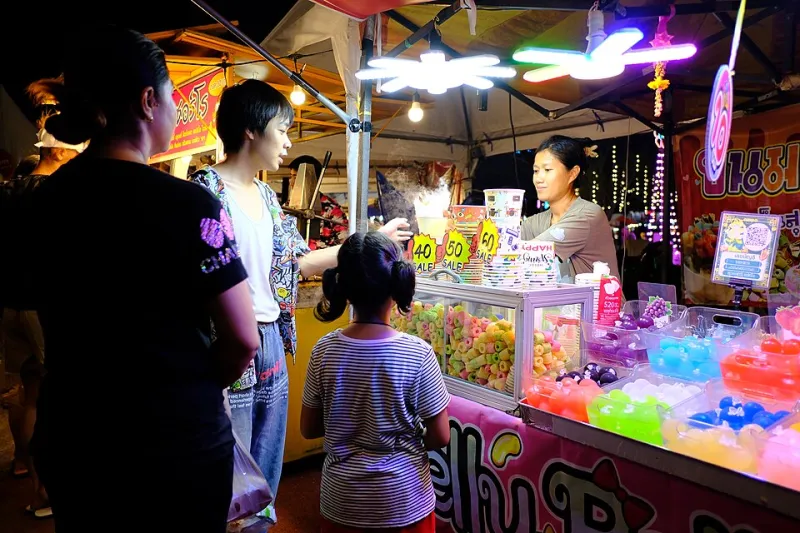
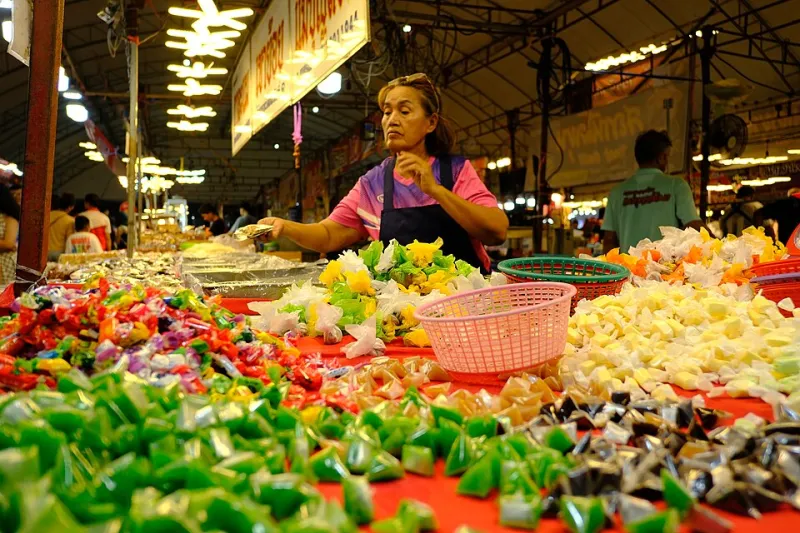
There's something else happening here that goes beyond algorithms and engagement rates. Thai candy mukbangs are, in a weird and wonderful way, replicating the experience of wandering through a night market.
If you've ever been to one — in Chiang Mai, Bangkok, or anywhere else in Thailand — you know the feeling. You're surrounded by colors and smells and sounds, vendors are handing you samples, and every few steps you encounter something you've never seen before. It's overwhelming in the best way possible.
Mukbang creators are channeling that energy through a screen. The discovery, the surprise, the communal joy of tasting something unfamiliar — it's all there, compressed into a five-to-fifteen-minute video.
"I think people are genuinely curious about Thai food culture, and candy is an accessible entry point," says Calloway. "It's not intimidating. You're not being asked to try something that might challenge you too hard. It's candy. But it opens a door."
What This Means for American Snack Culture
The ripple effects of this trend are already showing up in real-world demand. Google searches for specific Thai candy brands spike after viral mukbang moments. Online retailers report increased orders from regions that previously had zero Thai snack market presence. Some creators have even started curating their own Thai candy boxes to sell directly to their audiences.
And perhaps most interestingly, the trend is pushing mainstream American snack brands to take notice of the flavor profiles that Thai candy has popularized. Tamarind. Chili-mango. Salted coconut. These aren't fringe flavors anymore — they're moving into the mainstream, and mukbang culture is part of the reason why.
Thailand's candy tradition is centuries old, built on balance, complexity, and a deep understanding of how flavors interact. It just took a camera, a ring light, and a few million curious viewers to introduce it to the rest of the world.
And honestly? We're here for every single chew.